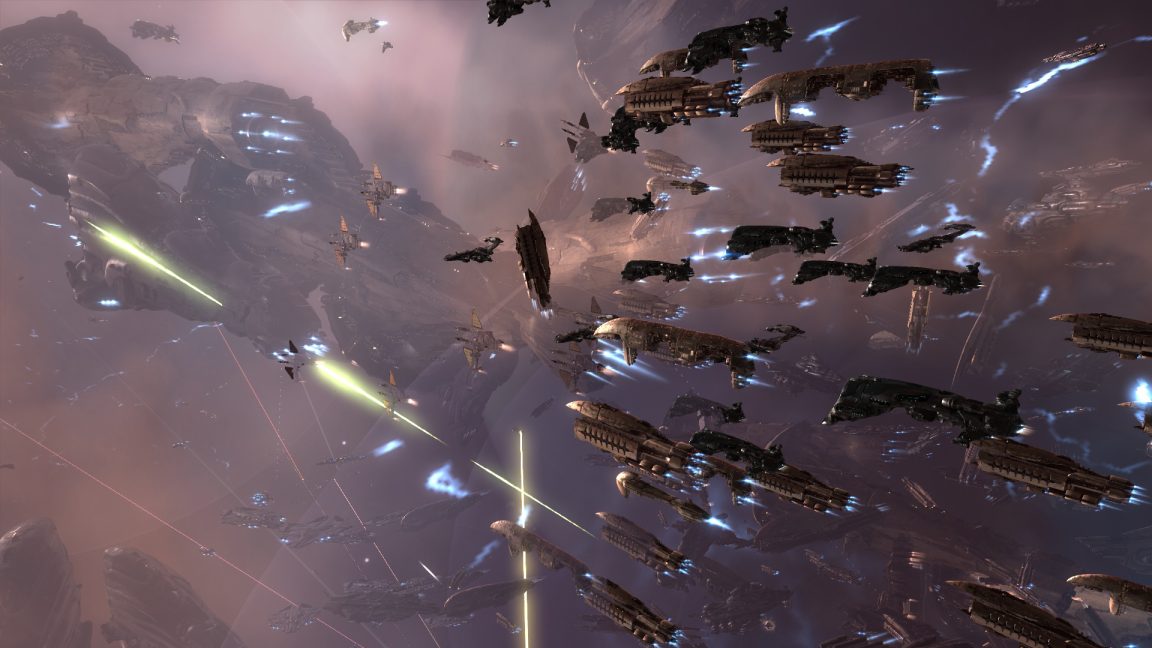
DeepMind’s minority stake in Fenris Creations plus an auditable offline replica turns EVE Online into a reproducible lab for lifelong RL. EVE’s multi‑scale temporal structure, endogenous distribution shift, and adversarial multi‑agent interactions force new architectures and evaluation protocols — not just bigger models — for agents that must operate robustly over months and years.
Games have driven ML progress before: Go crystallized search+policy, StarCraft exposed long‑horizon multi‑agent planning, Atari taught representations. EVE Online is different in kind. It’s a persistent, player‑run universe where economics, politics, and alliances evolve over weeks to years. Agents must handle distribution shift generated by other strategic actors.
DeepMind’s announced minority stake in Fenris Creations and the plan to run experiments against an offline, locally hosted replica turn New Eden from a live playground into a reproducible laboratory for lifelong RL — continual adaptation, episodic memory retrieval across months, and planning under strategic nonstationarity. That combination — a living economy plus an auditable offline replica — is the experimental lever needed to move short‑horizon RL toward systems that actually live and learn in the wild. (arstechnica.com)
Multi‑scale temporal structure and adversarial nonstationarity
Most RL benchmarks reset episodes and sample opponents from a fixed pool. They are intentionally short and near‑stationary.
EVE violates those assumptions. Its time constants span seconds (ship micro‑maneuvers), hours (fleet fights), days (campaigns and logistics), and months (economic cycles and political realignments). Agents must run reactive controllers and maintain long‑lived state that can be queried months later.
The distribution shifts agents face are endogenous: other adaptive, goal‑seeking players create the nonstationarity. Your actions change future training data. That turns learning into a continual, game‑theoretic problem rather than supervised curve‑fitting on i.i.d. data.
Standard episodic metrics — per‑episode return or imitation fidelity — miss the key failure modes here. They don’t detect long‑term drift, catastrophic forgetting after updates, or the need to recall rare but consequential events like betrayals or market collapses. Progress requires benchmarks and architectures built for multi‑timescale, adversarial environments — precisely the properties DeepMind highlights. (
arstechnica.com)
“EVE is one of the few environments where questions about intelligence can be explored inside something that already behaves like a living world.”
— arstechnica.com
Offline replica as an auditable experiment platform
Running RL experiments in a live MMO is ethically and experimentally fraught: research agents can disrupt player economies and social systems. Fenris and DeepMind avoid that by using a dedicated offline replica on local servers.
An offline replica provides two essentials: experimental isolation (no impact on live players) and full auditability (deterministic seeds, replayable traces, and dataset release). That makes controlled, repeatable studies possible.
A faithful replica is also an engineering bridge. You can snapshot world state, roll forward alternative interventions, run counterfactuals, and measure long‑horizon causal effects of policies. It enables standardized datasets: months of market transactions, alliance telemetry, and combat logs that can be archived and shared.
For reproducibility to be useful the replica must expose the right interfaces: fine‑grained state logs and social graphs; a deterministic mode with seedable RNGs; an agent API supporting asynchronous multi‑agent actions and batched rollouts; and tooling for rewinding and branching trajectories. The announcement’s emphasis on local, offline experiments suggests Fenris intends to provide this level of control, not just data dumps. (
arstechnica.com)
Architectural primitives for lifelong agents: episodic memory, modularity, hierarchy
Monolithic, short‑horizon policies trained end‑to‑end will fail in New Eden. Three primitives matter: episodic memory, modular continual learners, and hierarchical planners.
Episodic memory is essential because rare events carry outsized strategic value. Practically, integrate retrieval‑augmented policies: a policy network that queries a learned key‑value store of compressed episode embeddings indexed by time and social context. Make retrieval differentiable for hindsight updates, but allow non‑parametric escapes to preserve rare memories from overwriting.
Continual learning requires modularity to balance stability and plasticity. Expect mixtures of experts with gating conditioned on world state, and synaptic‑consolidation style regularizers for parameters that must remain stable. Meta‑controllers should route experience into fast (episodic), medium (policy fine‑tuning), and slow (world model) timescales so agents adapt quickly while retaining months‑long knowledge.
Hierarchy is necessary for cross‑timescale planning. Learn short‑horizon maneuvers as primitives. Compose them into operational objectives like fleet tactics or market maneuvers. Use model‑based planning at the strategic layer to roll counterfactuals and estimate the economic impact of actions such as disrupting a logistics route. These mechanisms are what DeepMind must probe to study long‑horizon planning and memory, not merely better short‑term play. (
arstechnica.com)
“We’re partnering with the developers of @EveOnline to explore the next frontier of AI research in games. EVE's complex, player-driven universe is the perfect safe sandbox to test agents on memory, continual learning, and long-term planning.”
— x.com
Reproducible benchmarks and evaluation protocols for lifelong RL
This collaboration must produce concrete, reusable benchmarks and protocols, not proprietary demos. Deliverables should be archived multimodal datasets, standardized lifelong RL tasks, and continuous evaluation servers.
Datasets: monthly snapshots of market trades, corporation membership graphs, fleet composition logs, and combat telemetry. Pair snapshots with metadata (patches, rule changes) so researchers can study covariate shift and concept drift. Use the replica’s branching to create counterfactual trajectories for causal analysis.
Benchmarks: define tasks that require months of stable performance — for example, maintain a profitable logistics route across two market cycles despite adversarial disruption. Measure cumulative reward, robustness to distributional change, forgetting (performance decay after interventions), and social impact (how an agent changes human player utility). These metrics force optimization for long‑term system health, not short wins.
Continuous evaluation servers: run held‑out replays where agents face unseen future states from human play or branched counterfactuals. Report leaderboards for stability curves over time as well as final returns. Done right, EVE becomes the first large public testbed where ‘lifelong’ is literal: months of learning, adaptation, and measurable societal effects, enabling the community to iterate on algorithms that actually survive in the wild.
End of story
Want tomorrow's dispatch in your inbox?
One dispatch per day at 06:00 UTC. No commentary, no ceremony.